The Manifesto of the Arena
I. Beyond Self-Referentiality
Painting for me is not a career choice, a brand, or a curated identity. It is a means of navigating existence itself. The act of painting is how I process uncertainty, mortality, wonder, and the contradictions of being alive.
Much of contemporary culture has become increasingly self-referential. Art often turns inward, examining systems of identity, power, culture, and art itself through endless cycles of interpretation and critique. While these conversations have their place, I find little interest in remaining trapped within them. Too often, meaning is treated as something constructed entirely through theory, language, or institutional approval.
My work begins from a different premise.
I believe there are realities that exist beyond human invention. Mountains, rivers, forests, weather, and time possess a presence that is not dependent upon our interpretation. They are older than our ideologies, older than our institutions, and indifferent to our attempts to categorize them.
Rather than looking inward toward increasingly abstract cultural systems, I look outward toward the physical world. The landscape offers something contemporary life rarely provides: direct encounter with forces larger than ourselves. It reminds us that human beings are participants in a far older story, not merely observers of our own reflection.
The landscape is not an escape from humanity. It is a return to it.
II. The Search for the Sublime
My work emerges from a distinctly American Romantic tradition. I am drawn to the sublime: those moments when beauty, mystery, scale, and uncertainty collide. Standing beneath old-growth forests, watching fog consume a valley, or witnessing light break across a mountain range can produce a feeling that is difficult to describe but impossible to ignore.
The Pacific Northwest provides an ideal arena for these encounters. Shaped by volcanoes, glaciers, floods, fault lines, and relentless weather, it remains one of the few places where human presence still feels secondary to the forces that formed it.
I do not seek picturesque scenery. I seek places that possess gravity. Places that challenge certainty. Places that force confrontation with something larger than oneself.
This search places me within a lineage of artists who understood that meaningful work emerges not from observation alone but from participation. From the American Romantic painters of the nineteenth century to the Northwest Mystics and the artists of Fishtown, I am drawn to those who immersed themselves in place rather than merely depicting it.
III. Immersion as Practice
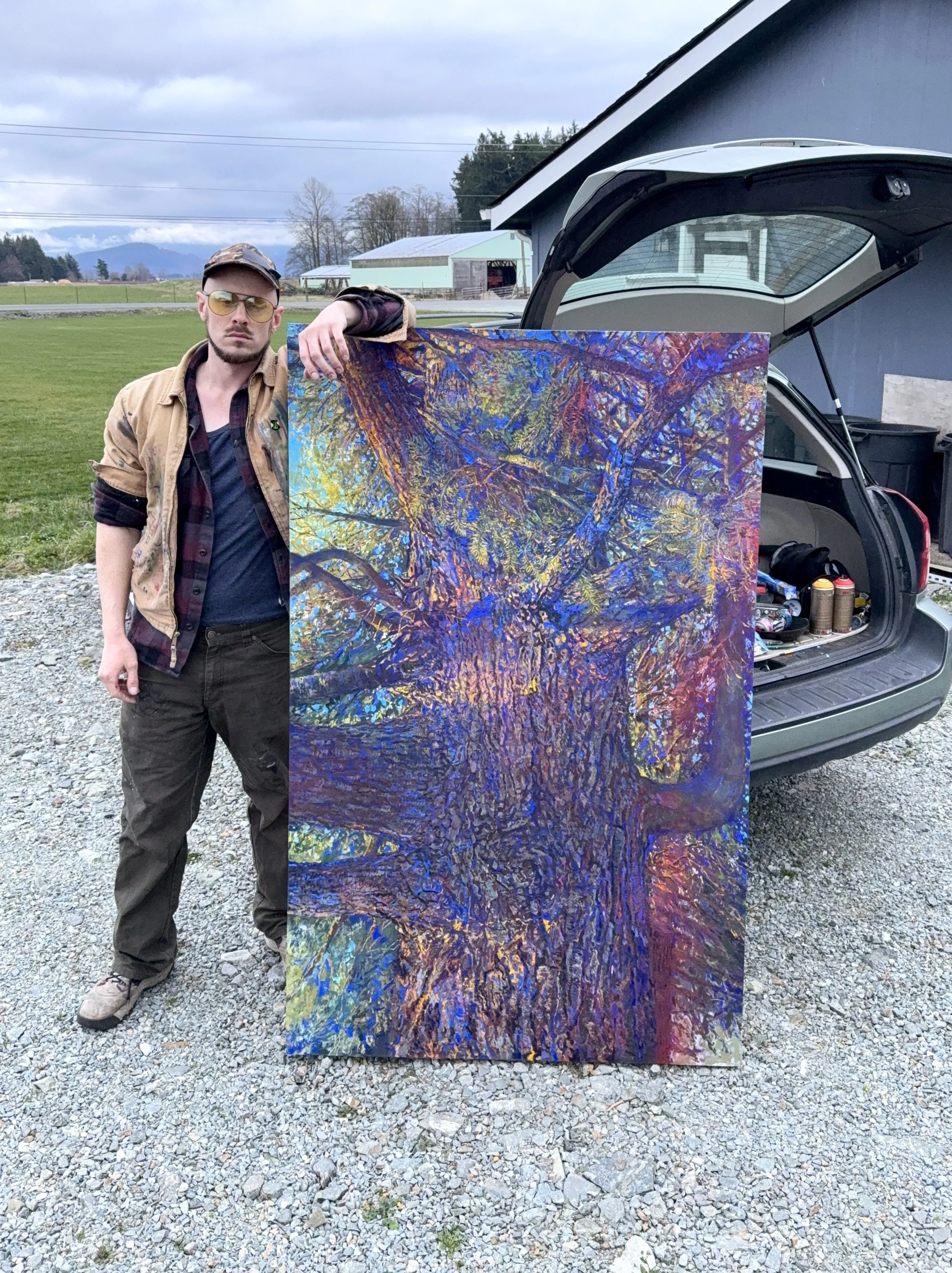
Every painting is created entirely on location. I carry canvases into remote forests, river valleys, shorelines, and mountain environments, often living in those places for days at a time. My vehicle functions as a mobile studio, allowing me to remain immersed in the landscape rather than simply visit it.
This immersion is essential.
The work is not merely about depicting a place. It is about participating within it. The changing weather, the exhaustion of travel, the silence of a forest, the search for an overlooked clearing, and the uncertainty of the wilderness all become part of the final image.
What begins as a search for locations inevitably becomes a search for experiences.
The painting becomes evidence of an encounter.
IV. The Rhythm of the Land
My visual language combines direct observation with abstraction. Atmospheric light, shifting weather, and the immediacy of plein air painting are merged with structural linework, rhythmic pattern systems, and layered mark-making.
I often think about painting in terms more commonly associated with music than representation. Tempo, rhythm, repetition, tension, release, and movement guide the construction of an image. Forests become networks of patterns. Rivers become directional currents. Mountains become structures through which the eye travels.
The goal is not to reproduce a landscape exactly as it appears, but to translate the experience of being there.
Spray paint and acrylics allow me to work at the speed demanded by the environment. Their immediacy mirrors the conditions under which the work is created. Every mark records a negotiation between intention and circumstance.
V. The Arena
I carry my canvases into the wilderness because I require friction.
I need an environment that does not care about my comfort, my control, or my expectations. Rain, cold, distance, fatigue, and uncertainty become collaborators in the process. The landscape is not a passive subject to be decorated. It is an active force that pushes back.
In this way, painting becomes both exploration and confrontation.
The search for the sublime is not separate from the struggle of existence; it is my response to it. Against distraction, I choose attention. Against passivity, I choose engagement. Against abstraction, I choose direct experience.
My paintings are records of searching, wandering, discovery, exhaustion, awe, and belonging. They are attempts to locate meaning within an indifferent universe and to create something enduring from fleeting encounters.
Every canvas stands as evidence that the search itself still matters.
Bio
Benjamin Vanderwerff’s relationship with art began at the age of three, drawing at the foot of his bed while his mother read to him. He has kept every sketchbook and piece of artwork from childhood through adulthood, a personal archive that reflects an early and enduring commitment to visual exploration.
He studied graphic design, a foundation that strengthened his understanding of structure, composition, and the clarity of an image. After completing his degree, Vanderwerff began painting outdoors and found that the direct experience of weather, terrain, and shifting light brought a sense of urgency and depth he could not achieve in the studio alone. This path eventually led him to Baja Mexico, where he lived and worked as an artist for four years. The desert, coastline, and open spaces of Baja profoundly shaped his approach to scale, color, and movement.
His practice is a unique convergence of large scale painting, mixed media experimentation, off roading, and overlanding culture. The remote places he seeks out, the conditions he works in, and the physical effort required to reach them all inform the energy and immediacy of his surfaces. Vanderwerff treats the landscape not as a distant subject but as an environment to inhabit, allowing cold, moisture, wind, and light to influence the work alongside his own decisions.
He has exhibited throughout Washington and in Baja California Sur, including shows at Harris Harvey Gallery, Lido Gallery, River Gallery, Cole Gallery, and various regional group exhibitions. He lives and works in the Skagit Valley of Washington, continuing to build a body of work rooted in exploration, place, and the lived experience of painting on location.